

Italian cars have long been celebrated for their exceptional design, performance, and craftsmanship. Renowned for blending art with engineering, these vehicles capture the essence of Italian automotive excellence and style.
From luxurious sports cars to groundbreaking innovations, each model represents a pinnacle of automotive history and continues to inspire car enthusiasts around the world.
Let’s explore more!
Alfa Romeo 33 Stradale
The Alfa Romeo 33 Stradale, introduced in 1967, is a pinnacle of automotive engineering, featuring a 2.0L DOHC V8 engine that produces 227hp. Enthusiasts of Italian sports cars are often captivated by the 33 Stradale’s blend of performance and aesthetic allure. Its V8 engine not only delivers impressive power but also produces a mechanical symphony that harmonizes with the car’s exquisite design.
The 33 Stradale’s lightweight body and distinctive gull-wing doors set it apart from other vehicles of its time. These features enhance its aerodynamics, contributing to a top speed of approximately 160 mph. The mid-engine layout ensures optimal weight distribution, improving both handling and performance and making every drive a memorable experience.
With only 18 units ever produced, the Alfa Romeo 33 Stradale is more than a car; it’s a rare piece of automotive history. Its limited production and unique design elements cement its status as one of the most iconic and desirable Italian sports cars ever created.
Owning or even seeing one is akin to stepping into a work of art that encapsulates the essence of Italian engineering and design.
Alfa Romeo GTA
Often regarded as a pinnacle of engineering, the Alfa Romeo GTA’s racing legacy showcases its dominance on the track and its contribution to motorsport history. The Alfa Romeo GTA, with its renowned racing heritage, solidified its legacy by becoming a symbol of motorsport royalty. Equipped with a 1.5L Twin Cam Inline-Four engine, this powerhouse produced up to 170hp, enabling the GTA to outpace its competitors effortlessly.
The GTA’s agility and performance were evident in its numerous victories across prestigious racing circuits. Alfa Romeo’s engineering prowess was on full display, as the car secured wins and garnered a reputation for exceptional handling and speed. This success on the track significantly boosted Alfa Romeo’s status in the racing world.
To illustrate the GTA’s impact, consider the following:
| Achievement | Details |
|---|---|
| Engine Power | 1.5L Twin Cam Inline-Four, up to 170hp |
| Racing Wins | Numerous victories in prestigious events |
| Motorsport Contribution | Paved the way for Scuderia Ferrari |
The Alfa Romeo GTA’s performance not only brought glory to Alfa Romeo but also played a key role in the foundation of Scuderia Ferrari by Enzo Ferrari. This racing legacy continues to inspire and maintain its iconic status in the annals of motorsport history.
Lightweight Design Innovation
Discussing the Alfa Romeo GTA necessitates recognition of its revolutionary lightweight design, which transformed the racing landscape. This car wasn’t merely about brute force; it epitomized engineering excellence. The Alfa Romeo GTA utilized aluminum body panels to significantly reduce its weight, a feature that was central to its exceptional agility and handling.
Its reduced weight facilitated quicker acceleration, more efficient braking, and superior cornering precision. This wasn’t a minor adjustment; it redefined performance standards. The emphasis on lightweight construction enabled the GTA to outperform many heavier competitors, establishing new milestones in the racing community.
The lightweight innovation of the Alfa Romeo GTA underscored the critical importance of agility and handling in racing. By eliminating excess weight and leveraging performance-enhancing materials, Alfa Romeo set a new benchmark.
Engine Performance Excellence
The Alfa Romeo GTA’s engine performance exemplifies engineering excellence with its 1.5L Twin Cam Inline-Four engine delivering an impressive 300hp. This power unit isn’t merely about brute force; it’s meticulously tuned to offer an exhilarating driving experience. Behind the wheel, drivers experience the harmonious blend of power and responsiveness that has distinguished the Alfa Romeo GTA in the world of motorsport.
Engine performance excellence is central to the GTA’s design. Employing advanced technology and achieving high power output, it set new standards in its era. The precision and agility of its engine played a pivotal role in the car’s racing triumphs, establishing it as a formidable competitor on the track. Few vehicles of its time could rival the combination of its lightweight structure and powerful engine.
The Alfa Romeo GTA didn’t just participate in races; it excelled, thanks to its outstanding engine performance. Its status as an iconic Italian sports car is well-earned, with numerous victories in motorsport competitions solidifying its legendary reputation. When considering performance excellence, the Alfa Romeo GTA’s engine capabilities are indisputably top of mind.
De Tomaso Pantera
De Tomaso’s Pantera exemplifies a harmonious fusion of Italian elegance and American power, establishing it as a true icon in exotic car design. Introduced in 1971, this mid-engine supercar distinguishes itself with impeccable Italian styling and formidable American performance. The Pantera’s sleek, aggressive lines epitomize the finest in Italian design, while its mid-engine configuration ensures superior handling and balance.
Admiring the Pantera reveals the quintessence of Italian craftsmanship. From the sculpted bodywork to the meticulously detailed interior, every aspect of this car exudes sophistication. The integration of these design elements with a robust 5.8L V8 engine, generating 330hp and 344ft-lbs of torque, truly differentiates the Pantera. This powerhouse provides the performance to match its stunning aesthetics.
The Pantera’s distinctive blend of Italian elegance and American muscle made it a standout in its era and a timeless classic today. Its design not only captivated car enthusiasts but also set a new benchmark in the exotic car segment, demonstrating that beauty and strength can indeed coexist seamlessly.
American Muscle Power
This legendary sports car perfectly melds Italian elegance with brute American force, making it a standout in the US market.
The Pantera’s Ford V8 engine delivers an impressive 330 horsepower and 344 ft-lbs of torque, allowing it to reach a top speed of 174 mph. Its mid-engine layout offers a balanced and exhilarating driving experience, blending power and agility.
The Pantera didn’t just captivate with its raw power; it also excelled in handling and braking, making it a complete package for driving enthusiasts. With a production run exceeding 7,000 units, this collaboration between De Tomaso and Ford birthed a high-performance marvel that remains iconic to this day.
- Italian styling meets American muscle for a distinct look.
- The 5.8L Ford V8 engine provides robust power and torque.
- A mid-engine layout maintains balanced weight distribution.
- Top speed of 174 mph showcases its high-performance capabilities.
- Over 7,000 units produced, marking its popularity and legacy.
Racing Legacy
The De Tomaso Pantera’s racing legacy underscores its reputation as a high-performance machine capable of dominating the track. Powered by a 5.8L V8 engine delivering 330hp and 344ft-lbs of torque, the Pantera seamlessly merged Italian styling with American muscle. This unique combination made it a standout among Italian classics and a formidable contender in the racing world.
The Pantera’s mid-engine layout and sleek design significantly contributed to its impressive handling and brake modulation, making it a favorite on various racing circuits. Although it wasn’t primarily built for World Rally Championships, its performance credentials were bolstered through collaboration with Ford for the engine supply, solidifying its status as an icon in Italian automotive history.
Produced from 1971 to 1992, more than 7,000 units primarily catered to the US market. Yet, its racing legacy and the blend of Italian design flair with American power make it a milestone among classic cars.
Ferrari 250 GTO

Among the most revered classic cars, the Ferrari 250 GTO stands out for its unparalleled combination of rarity, beauty, and racing prowess. This automotive legend was crafted with a singular purpose: racing homologation. Only 36 units were ever produced, making it one of the rarest and most sought-after cars in history. The Ferrari 250 GTO features a powerful V12 engine, a marvel of engineering at the time, delivering both speed and reliability on the race track.
The design, masterminded by Sergio Scaglietti, is iconic. Each curve and line of the Ferrari 250 GTO contributes to its timeless beauty and aerodynamic efficiency.
Ferrari 330 P4

Featuring a powerful 4.0L V-12 engine, the Ferrari 330 P4 is a legendary racing car that epitomizes speed and engineering excellence. With 450 horsepower and 385 lb-ft of torque, this machine isn’t just about performance; it’s also a marvel of design. Its aerodynamic bodywork, combined with the iconic red paint scheme, makes it instantly recognizable on any track.
The Ferrari 330 P4 made its mark in endurance races, particularly at the 24 Hours of Le Mans. Here, it showcased exceptional speed, reliability, and endurance—qualities essential for such grueling competitions. This racing car wasn’t just fast; it symbolized Ferrari’s commitment to dominating motorsport history.
Only a few examples of the Ferrari 330 P4 were ever produced, adding to its allure and making it one of the most desirable and valuable classic racing cars in the world. Its racing success and timeless beauty have cemented its status as an enduring symbol of Ferrari’s prowess in the racing world.
For fans of motorsport history, the Ferrari 330 P4 stands out as a reflection of what makes Italian cars iconic.
Ferrari F40

The Ferrari F40 stands out with its turbocharged V8 engine and lightweight carbon fiber construction.
The twin-turbo 2.9L V8 produces an impressive 471hp, pushing the limits of automotive engineering in the late ’80s.
Coupled with its minimal weight, the F40 provides a raw and exhilarating driving experience that remains highly regarded by enthusiasts today.
Turbocharged V8 Engine
Introduced in the late 1980s, the Ferrari F40’s twin-turbocharged 2.9L V8 engine produces an astounding 471 horsepower. This engine is the core of the F40, delivering exceptional acceleration and a top speed that continues to impress even by today’s standards. With 426 lb-ft of torque, every drive is both thrilling and engaging.
Acceleration: The turbocharged V8 provides blistering acceleration, making 0-60 mph sprints feel instantaneous.
Top Speed: Capable of reaching around 201 mph, it was one of the fastest cars of its era.
Engine Sound: The roar of the V8 is music to the ears of any car enthusiast.
Performance: The engine’s responsiveness ensures every drive is exhilarating.
Legacy: The F40’s engine set a new benchmark for supercar performance.
Experience the legend of the Ferrari F40 with every press of the accelerator.
Lightweight Carbon Fiber
The Ferrari F40 is renowned as one of the first production cars to extensively incorporate lightweight carbon fiber materials in its design. By utilizing carbon fiber components, Ferrari significantly reduced the car’s weight while preserving its strength and rigidity. This innovative approach was crucial in establishing the F40’s legendary status in the automotive industry.
Ferrari’s use of carbon fiber was fundamental to enhancing the car’s performance. The lightweight construction ensured an exceptional power-to-weight ratio, resulting in rapid acceleration and superior handling dynamics. The car’s responsiveness to driver input is a testament to its advanced engineering.
Here are the key benefits of using carbon fiber in the Ferrari F40:
| Feature | Benefit |
|---|---|
| Lightweight | Improved acceleration |
| High strength | Enhanced rigidity |
| Reduced weight | Better handling |
| Advanced engineering | Superior performance |
| Innovative materials | Cutting-edge technology |
The extensive use of carbon fiber in the Ferrari F40 set a new benchmark for production cars. It demonstrated Ferrari’s dedication to advancing automotive technology and innovation, solidifying the F40’s status as an enduring icon in the world of supercars.
Fiat 500

In 1957, Fiat introduced the 500, a compact car that quickly became an icon in Italian automotive history and urban culture. Its distinctive design made it perfect for navigating narrow city streets and tight parking spots. Despite its small 0.5L Twin-Cylinder engine, producing a modest 18hp, the Fiat 500 offered sufficient power for agile city driving.
The Fiat 500 stood out not just for its practicality but also for its timeless charm and affordability. It became more than just a vehicle; it symbolized post-war Italy’s economic recovery and urban renaissance.
Key features that contributed to the Fiat 500’s enduring classic status include:
Compact Design: Ideal for maneuvering through narrow urban streets.
Affordability: Accessible to a broad audience, making it perfect for everyday use.
Cult Following: Its unique style and practicality garnered a dedicated fan base.
Versatility: Despite its small size, it was suitable for various uses.
Modern Iterations: New versions maintain the classic appeal with updated features.
The Fiat 500’s lasting popularity attests to its iconic status in Italian automotive history.
Iso Grifo

The Iso Grifo, produced from 1963 to 1974, epitomizes the fusion of Italian elegance and American muscle, marking it as a standout in automotive history. This grand tourer marries exquisite Italian design with formidable American power, creating a unique and highly revered vehicle.
Visually, the Iso Grifo exudes Italian craftsmanship with its sleek and striking appearance. Beneath its hood lies a robust 7.0L OHV V8 engine, capable of delivering an impressive 395 horsepower and 460 ft-lbs of torque, underscoring its status as a true powerhouse.
Performance-wise, the Iso Grifo is as exhilarating as it looks. It boasts a top speed of approximately 171 mph, offering both thrilling speed and exceptional driving pleasure. Designed as a grand tourer, it provides a balance of performance and comfort, making it ideal for long journeys while ensuring you make a statement wherever you go.
Highly prized by collectors, the Iso Grifo’s blend of style and power makes it a rare gem in the realm of classic cars. Whether you’re an enthusiast or a collector, the Iso Grifo remains an iconic piece of automotive history, celebrated for its charm and prowess.
Lamborghini Countach LP 400
Introduced in 1974, the Countach LP 400 featured a powerful 4.0L DOHC V12 engine, delivering 370hp and 266ft-lbs of torque. This vehicle not only turned heads but also set new standards for supercar aesthetics and performance.
The LP 400 variant showcased cutting-edge technology and became a symbol of Lamborghini’s bold and daring identity. With a top speed of 186 mph, this wedge-shaped marvel continues to captivate automotive enthusiasts worldwide.
Lamborghini Miura

The Lamborghini Miura, introduced in 1966, revolutionized the automotive world with its groundbreaking mid-engine layout and stunning design. This innovative configuration not only transformed the aesthetics of sports cars but also redefined performance standards. The Miura’s mid-engine layout provided exceptional balance and handling, solidifying its status as the first true supercar.
Powering the Miura was a robust 4.0L DOHC V-12 engine, delivering 360 horsepower. This potent engine enabled the Miura to reach a remarkable top speed of 171 mph, making it one of the fastest cars of its era. The car’s performance was complemented by its striking design, characterized by sleek lines and a low-slung profile that captivated both enthusiasts and critics.
The later variant, the Lamborghini Miura P400SV, elevated the performance further with an increase to 385 horsepower. Despite its limited production, the P400SV reinforced the Miura’s legendary status.
Admiring the Miura isn’t just about appreciating a car; it’s about recognizing a pivotal piece of automotive history that set the stage for future supercars.
Lancia Aurelia B24 Spider
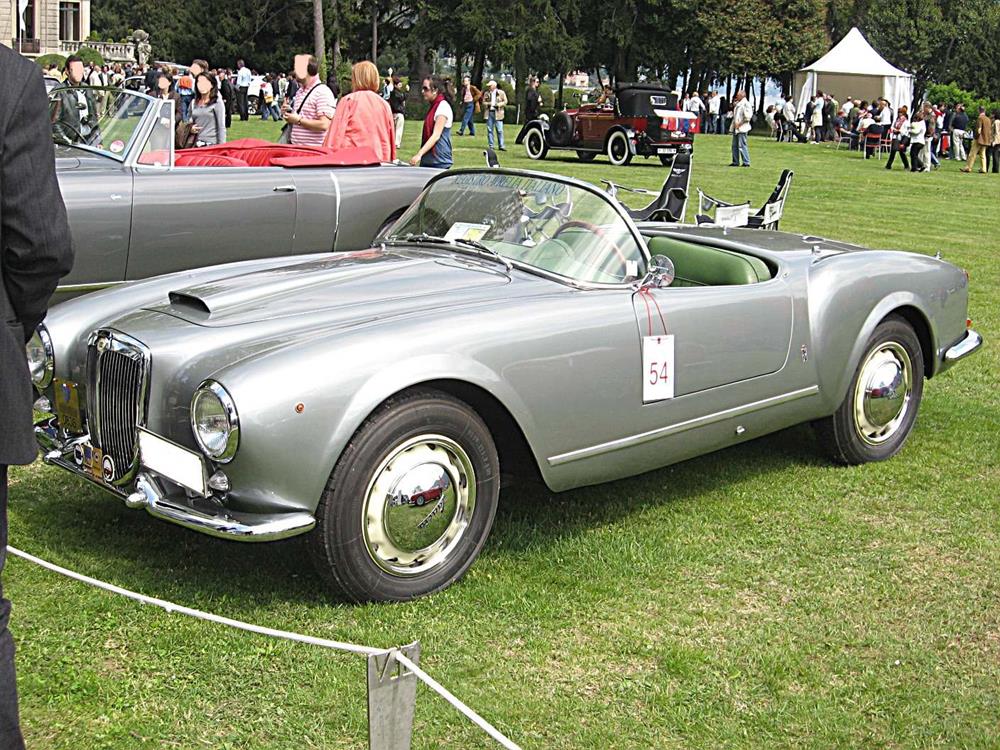
With its luxurious convertible design and powerful performance, the Lancia Aurelia B24 Spider stands as a true icon of 1950s Italian automotive excellence. This convertible sports car captured the hearts of enthusiasts with its blend of elegance and engineering prowess. When you think of a classic Italian car, the B24 Spider surely comes to mind.
The Lancia Aurelia B24 Spider is celebrated for several key reasons:
Exquisite Design: The sleek lines and elegant curves made it one of the most beautiful cars of its era.
Powerful Engine: It featured a 2.5L OHV V6 engine producing 118hp and 127ft-lbs of torque, delivering a thrilling driving experience.
Limited Production: With only a limited number produced, it remains a rare and highly sought-after vehicle among collectors.
Innovative Engineering: Lancia’s commitment to cutting-edge technology and design is evident in every detail of the B24 Spider.
Historical Significance: This car solidified Lancia’s place in automotive history, symbolizing the pinnacle of 1950s Italian craftsmanship.
The Lancia Aurelia B24 Spider isn’t just a car; it’s a piece of art and a reflection of an era of Italian automotive brilliance.
Lancia Delta Integrale
Few cars have achieved the legendary status of the Lancia Delta Integrale in the world of rally racing. As a turbocharged rally legend, the Delta Integrale captivated enthusiasts with its remarkable performance and iconic design. This powerhouse secured six consecutive World Rally Championships from 1987 to 1992, a feat that highlighted its unmatched dominance on the rally circuit.
The Lancia Delta Integrale’s success can be attributed to several key features:
Turbocharged Engine: The 2.0L Inline-Four engine, delivering 165hp and 192ft-lbs of torque, provided the necessary power for rally stages.
All-Wheel-Drive System: Ensured top-notch traction and handling across diverse terrains, from gravel to snow.
Aerodynamic Enhancements: Wide fenders and other design tweaks improved stability at high speeds.
Robust Suspension: Capable of absorbing the intense impacts and irregularities of rally courses.
Driver-Centric Interior: Focused on giving the driver precise control and feedback during demanding races.
The Delta Integrale’s combination of advanced engineering and strategic design made it a formidable competitor, and its rally success solidified its reputation as an all-time great.
Turbocharged Performance Legacy
The Lancia Delta Integrale’s turbocharged performance legacy epitomizes engineering brilliance and a competitive spirit. Introduced in 1987, the Delta Integrale distinguished itself with a turbocharged 2.0L inline-four engine, producing 165 hp and 192 ft-lbs of torque. This power enabled the vehicle to dominate the rally racing scene.
Rally racing demands more than just speed; it requires precision and control over diverse terrains. The Delta Integrale’s all-wheel-drive system was revolutionary, offering exceptional traction and stability. This combination of a turbocharged engine and advanced all-wheel-drive system enabled the Integrale to excel on gravel, mud, and tarmac alike.
Beyond performance, the Delta Integrale’s iconic Martini Racing livery and distinctive design made it a symbol of rallying success. Its striking appearance, coupled with its formidable rally pedigree, showcased Italian automotive innovation at its best. The car’s six consecutive World Rally Championships from 1987 to 1992 validate its unparalleled engineering and competitive edge.
The Lancia Delta Integrale’s turbocharged powerplant and rally achievements have cemented its status as one of the most iconic Italian cars of all time.
Lancia Stratos

Imagine a rally car so iconic that it not only dominated the World Rally Championship for three consecutive years but also left an indelible mark on automotive history—the Lancia Stratos. This purpose-built rally car features a mid-engine layout and a distinctive wedge-shaped design that continues to captivate enthusiasts.
Powered by a Ferrari V6 engine, the Stratos delivers 187 horsepower and 165 lb-ft of torque, making it a formidable competitor. The Lancia Stratos achieved remarkable success, clinching the World Rally Championships from 1974 to 1976. Its lightweight construction and exceptional handling were critical in securing these victories, establishing the Stratos as a legend in the rally scene.
Here are some standout features that make the Lancia Stratos unforgettable:
Mid-engine layout for excellent balance and handling.
Wedge-shaped design, a hallmark of 1970s automotive aesthetics.
Ferrari V6 engine providing strong power and performance.
Three consecutive World Rally Championships (1974-1976).
Lightweight construction enhancing its agility and speed.
The Lancia Stratos remains an iconic and revered model, symbolizing Italian engineering prowess and racing heritage. If you’ve ever wondered what makes a car legendary, the Stratos is the perfect example.
Maserati 250F

Shifting gears from rally to Formula 1, the Maserati 250F stands as a testament to Italian engineering brilliance. Introduced in 1954, the 250F quickly became a dominant force on the Formula 1 circuit. Its powerful 2.5-liter engine and advanced engineering set it apart from its competitors, making it a symbol of Maserati’s commitment to excellence in motorsport.
One of the most notable drivers to pilot the 250F was the legendary Juan Manuel Fangio. Fangio drove the Maserati 250F to numerous victories, solidifying its place in racing history. His skill, combined with the car’s technical prowess, showcased Maserati’s dedication to creating top-tier racing machines. The 250F wasn’t just a car; it was a reflection of Maserati’s racing heritage and innovation.
The Maserati 250F achieved significant success during its era, further cementing Maserati’s reputation in the world of Formula 1. Its legacy is still celebrated today, and it’s remembered as one of the most iconic racing cars ever built.
For fans of racing history, the Maserati 250F epitomizes the golden age of Formula 1 and Italian engineering excellence.
Pagani Zonda C12
Introduced in 1999, the Pagani Zonda C12 marked the impressive debut of Pagani Automobili with its stunning design and powerful Mercedes-Benz V12 engine. This car didn’t just turn heads; it redefined what a supercar could be with its unparalleled blend of performance and luxury.
The Zonda C12’s Mercedes-Benz V12 engine initially produced 394 horsepower, showcasing its raw power and engineering excellence. The car’s exterior featured distinctive gull-wing doors and a lightweight carbon fiber body, making it not only visually striking but also highly aerodynamic and robust.
A key aspect of the Zonda C12 was its high level of customization. Pagani offered a variety of bespoke options, allowing discerning buyers to tailor the car to their exact preferences.
Some standout features that make the Zonda C12 truly iconic include:
Mercedes-Benz V12 engine: Delivering robust performance.
Gull-wing doors: Adding a dramatic flair.
Carbon fiber body: Lightweight and strong.
High levels of customization: Tailor-made luxury.
Exclusive craftsmanship: Each unit meticulously built.
The Pagani Zonda C12 didn’t just debut; it made a grand entrance into the world of supercars, setting a high bar for future models.
Conclusion
The legacy of Italian cars reflects the country’s unparalleled dedication to automotive artistry and performance. The 15 most iconic Italian cars of all time exemplify this rich heritage, showcasing the perfect fusion of design and engineering that has captivated enthusiasts for decades.
These legendary models highlight Italy’s contributions to the automotive world and continue to influence and inspire future generations. As we celebrate their history, we recognize the timeless appeal and enduring impact of these remarkable vehicles.
