
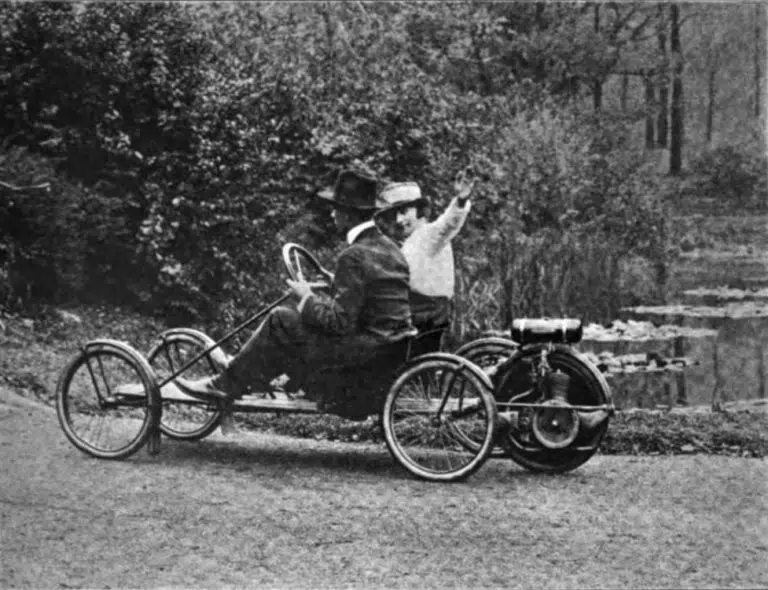
The Smith Flyer was a pioneering motorized buckboard that redefined personal transportation in early 20th-century America. Manufactured between 1915 and 1919 by the A.O. Smith Corporation of Milwaukee, the Flyer’s minimalist wooden frame and innovative fifth-wheel motor design made it the most inexpensive production vehicle of its time.
Later renamed the Briggs & Stratton Flyer, and popularly known as the Red Bug, this unique vehicle bridged the gap between bicycles and cars, leaving a lasting imprint on automotive history.
Key Takeaways
-
Introduced in 1915 by A.O. Smith Corp., based on Arthur Wall’s 1910 motor-wheel concept.
-
Featured a wooden buckboard frame and a fifth-wheel gasoline engine, making it highly affordable.
-
Rights were sold to Briggs & Stratton in 1919, which increased engine power from 1.5 to 2 horsepower.
-
Known as the Briggs & Stratton Flyer or “Red Bug,” it was the cheapest production car ever made.
-
Production ended in 1925, but it remains highly collectible, with auction prices reaching over $27,000.
Origins of the Smith Flyer
The Smith Flyer originated in 1915 as a project of the A.O. Smith Corporation, drawing direct inspiration from the 1910 AutoWheel designed by British engineer Arthur Wall.
Constructed from a simple wooden buckboard frame with bicycle wheels, the Flyer stood out due to its fifth wheel motor, which housed a gasoline engine that directly propelled the vehicle.
This motor-wheel concept eliminated the need for complex transmission systems. Initially, the Flyer was sold for $125 to $150, a price that earned it recognition in the Guinness Book of World Records as the world’s cheapest car.
Design and Engineering Innovations
The Smith Flyer’s appeal lay in its simplicity and ingenuity. Its core innovations included:
-
Lightweight wooden frame for affordability and ease of assembly.
-
A rear-mounted fifth wheel with a self-contained motor (initially 1.5 horsepower).
-
No clutch, gearbox, or differential—resulting in ultra-simple mechanics.
-
A lever-based starting system for user-friendly ignition.
When Briggs & Stratton took over in 1919, they improved the engine, increasing output to 2 horsepower using a larger bore and steel components.
Ford’s pioneering production methods set the standard for mass manufacturing in the automotive industry, demonstrating the lasting impact of innovation during the early 20th century.
Evolution Into the Briggs & Stratton Flyer
https://commons.wikimedia.org/wiki/File:SmithFlyer.jpg
In 1919, Briggs & Stratton acquired the rights to the Flyer and rebranded it as the Briggs & Stratton Flyer. Enhancements included:
-
A more powerful 2 hp gasoline engine.
-
Greater mechanical durability with steel internal parts.
-
Mass marketing under the nickname “Red Bug” due to its vivid red paint.
The vehicle remained a popular novelty and practical transport solution into the early 1920s. By 1925, Briggs & Stratton sold the design to the Automotive Electric Services Corporation, which introduced electric motor variants.
In a similar fashion, General Motors was known for its pioneering innovations like developing the first air conditioning system for cars, which set industry standards and influenced automotive design.
Market and Cultural Impact
The Flyer’s affordability and distinctive design gave it broad cultural and economic significance. Key impacts included:
-
Widespread accessibility in personal transportation for low-income consumers.
-
Marketing through “Motor Wheel Age” and exhibitions fueled public fascination.
-
Thousands of units sold before production ceased in 1925.
Despite its short production span, the Flyer symbolized the democratization of motor travel during an era of rapid technological change.
Transition to the Red Bug and Electric Models
https://commons.wikimedia.org/wiki/File:21-04-001-car.jpg
Post-1925, the Flyer’s legacy continued under the name Red Bug, produced by the Automotive Electric Services Corporation. The vehicle evolved to include:
-
Electric versions, catering to niche buyers and amusement park transport.
-
Continued use of the iconic buckboard layout with minimal mechanical complexity.
These versions retained the charm of the original while pushing the boundaries of low-cost electric mobility.
Collectability and Current Market Value
Today, the Smith/Briggs & Stratton Flyer holds a revered place among collectors. Key facts include:
-
Auction prices range from $8,000 to $27,500, depending on condition and originality.
-
Notable sales include $12,100 in 2007 and $27,500 in 2019.
-
The vehicle’s historic status as the world’s cheapest car adds to its allure.
-
Replica builds remain common due to its basic design and widespread documentation.
Legacy and Influence on Future Automotive Designs
| Year | Event | Significance |
| 1910 | Arthur Wall develops the AutoWheel in the UK | Inspires future motor-wheel technology used in the Smith Flyer |
| 1915 | A.O. Smith Corporation introduces the Smith Flyer | Launch of an affordable, motorized buckboard with a fifth-wheel engine |
| 1919 | Briggs & Stratton acquires rights to the Flyer | Rebrands the vehicle and improves engine from 1.5 hp to 2 hp |
| 1922 | Recognized by Guinness as the world’s cheapest car | Sold for $125–$150, making it the least expensive production vehicle |
| 1925 | Rights sold to Automotive Electric Services Corp. | Company develops electric versions; the vehicle becomes known as the “Red Bug” |
| Post-1925 | Red Bug used in resorts and amusement parks | Gains niche popularity in leisure and novelty transportation |
The Flyer’s influence reaches beyond novelty. It pioneered concepts foundational to future developments:
-
Demonstrated the potential for low-cost, minimalist vehicle design.
-
Served as a precursor to cyclecars and small-engine vehicles of the 1920s–30s.
-
Set performance benchmarks for small-engine innovation at Briggs & Stratton.
-
Highlighted the practicality of direct drive motor systems.
Its legacy continues in how automotive engineers approach lightweight mobility and accessible design.
